 ResoluteMake my plan
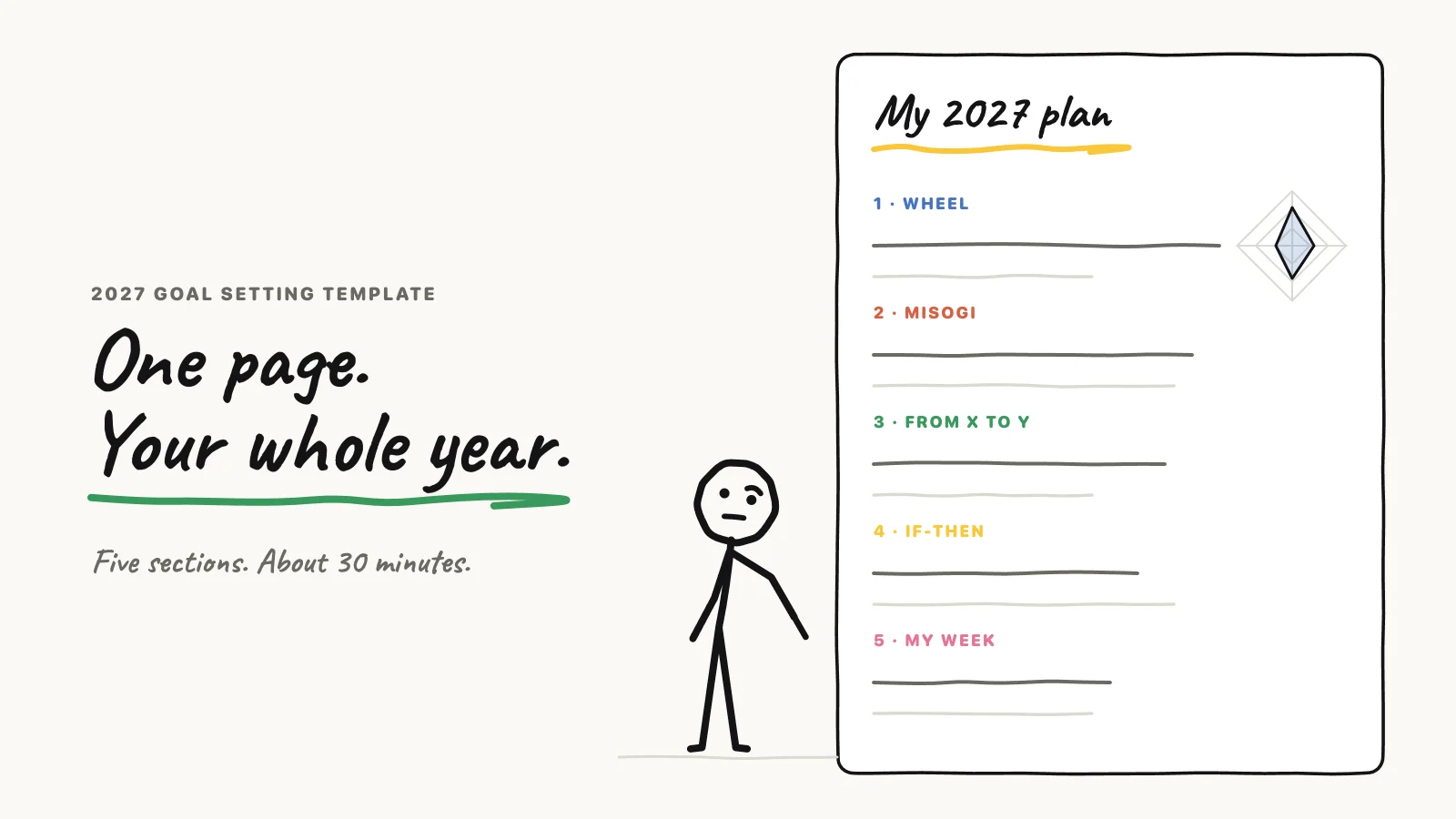
Most goal setting templates are a box that says "Goals" and a box that says "Action steps."
That's not a template. That's a blank page with a border.
This one is different. It's one page, five sections, and every section exists because goals tend to die in that exact spot. It takes about 30 minutes. You can fill it in right here on the page, or copy the plain-text version at the end.
The five sections are explained below, and the plain-text version to copy is at the end.
Section 1: Wheel of Life scores
Rate each area of your life from 1 to 10. Not the score you'd post online. The real one.
- Career: __ / 10
- Health & Fitness: __ / 10
- Knowledge & Skills: __ / 10
- Relationships: __ / 10
Why it's here: most people plan their year from where they wish they were, not from where they are. Thirty seconds of honest scores show you which area has been quietly sitting at a 3 for years. That's usually where your best goal is hiding. (More on how to read it: The Wheel of Life in 15 minutes.)
Section 2: Your goals and your Misogi
Imagine it's December 31, 2027. You're toasting to the best year of your life. What are you celebrating? Write at most one win per area.
Then circle one: your Misogi, your main goal for 2027. Ask:
- Which one would make the others easier?
- Would I still be proud of it at 80?
- Which one scares me a little?
Why it's here: a list of four equal goals is four goals competing for the same evenings. The Misogi tells you which one wins when you can't do everything. Need ideas? Here are 75 Misogi challenge ideas and examples of 2027 goals by area.
Section 3: From X to Y by a date
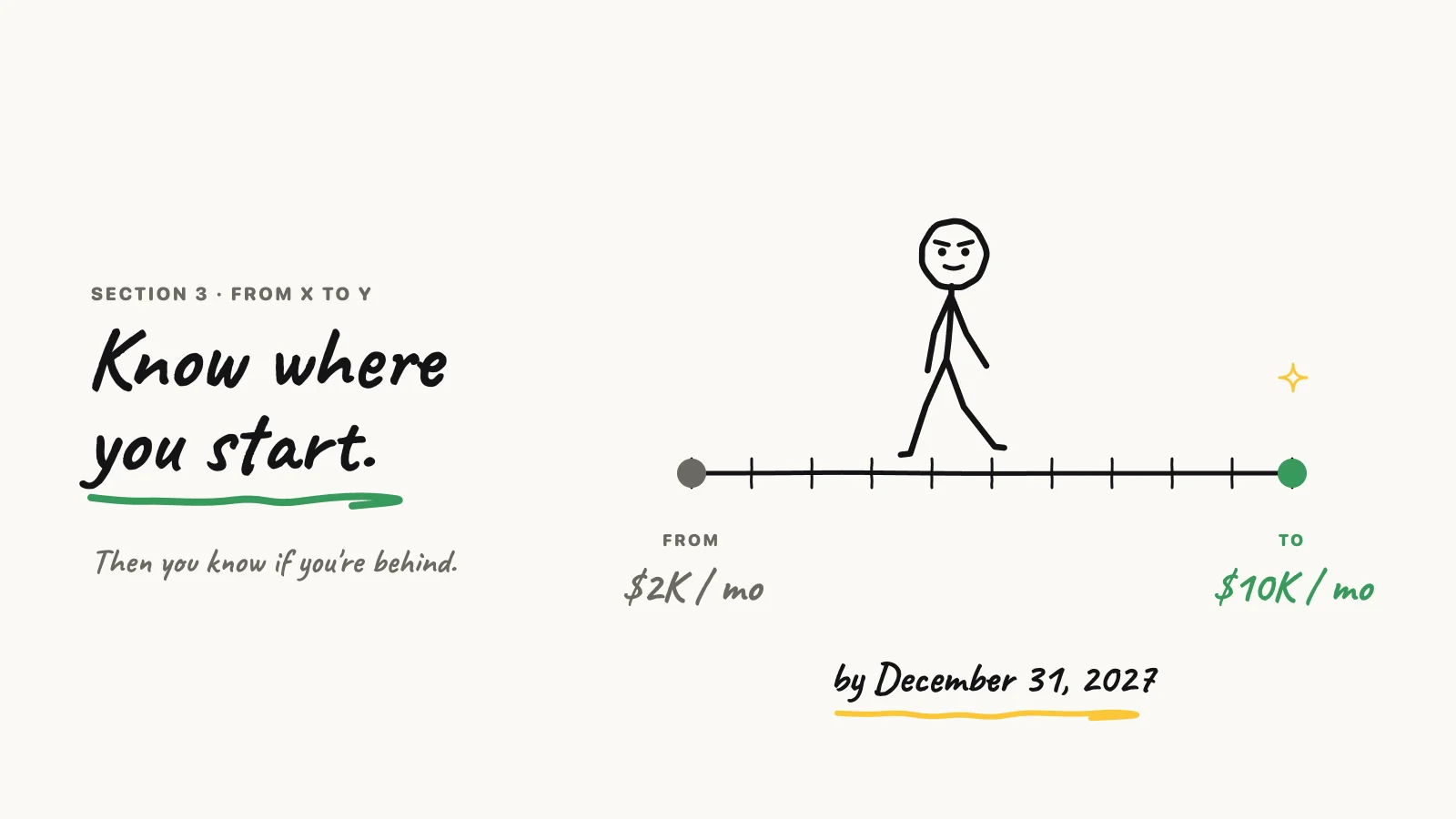
Give every goal a finish line. Use one of two sentences:
- A number you'll hit: From [where I am today] to [target] by [date]. → "From $2K to $10K a month by December 31."
- A moment that will happen: By [date], I'll have [moment]. → "By October 15, I'll have crossed a marathon finish line."
Why it's here: "make more money" can never be done. Writing down your starting point matters as much as the target: it's how you'll know, every single week, if you're ahead or behind.
Section 4: Obstacles and if-then plans
Write down what has stopped you before. Be honest: procrastination, being too tired after work, losing motivation after a few weeks, a chaotic schedule, fear of failing.
Then, for each one, write an if-then plan: a decision made in advance.
- If I get home exhausted, then I put on my shoes and go for 10 minutes.
- If work gets crazy, then I protect my Misogi blocks and drop the rest.
- If I miss a day, then I never miss two in a row.
Why it's here: your plan is written by the motivated version of you. This section is for the tired one. If-then plans (psychologists call them implementation intentions) are one of the most studied tools in goal research. Here are 30 if-then examples.
Section 5: Your weekly blocks
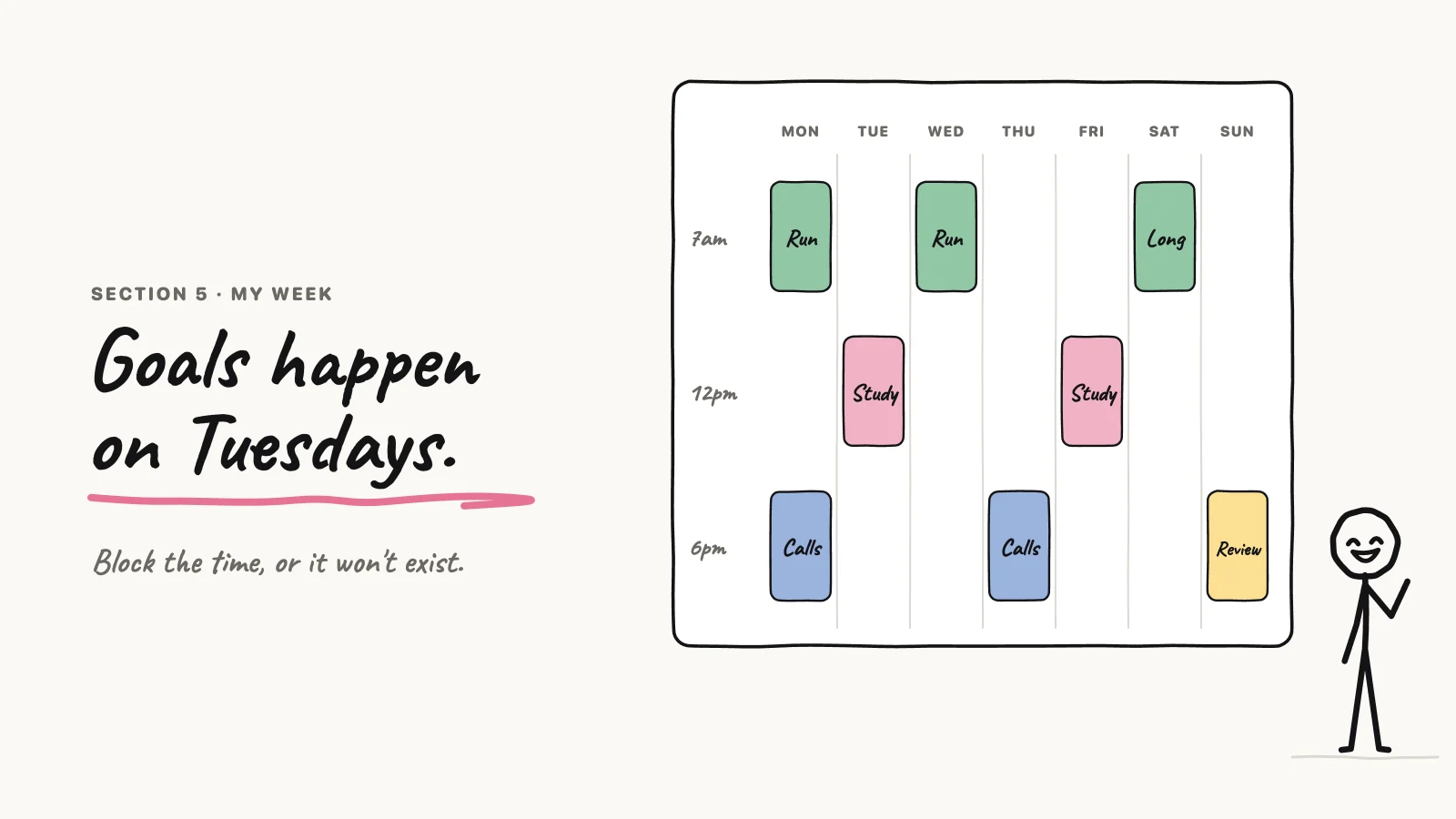
For each goal, decide what you'll actually do, and how often. Focus on actions you control, not outcomes. "Lose 5 kilos" is an outcome. "Strength training 3× a week" is an action.
Then give each weekly action a day and a time, Misogi first:
- Monday, Wednesday, Friday, 7:00am: strength training.
- Tuesday and Thursday, 12:30pm: 30 minutes of Spanish.
- Sunday, 6:00pm: weekly review, 20 minutes.
Why it's here: goals happen on Tuesdays, not in January. A goal without a time in your calendar is a wish. And the Sunday block is the one that keeps all the others alive (here's how to run a weekly review).
One last tip: test-drive your week before January 1. Live it for a few days in late December. You'll find the blocks that don't fit while it's still easy to move them.
The plain-text template (copy it)
Paste this into your notes app, a doc or a notebook:
MY 2027 PLAN

1. WHEEL OF LIFE (1–10)
   Career: __   Health & Fitness: __   Knowledge & Skills: __   Relationships: __
   Area with the most room to grow: ____________

2. DECEMBER 31, 2027 – WHAT I'M CELEBRATING
   Career: ____________
   Health & Fitness: ____________
   Knowledge & Skills: ____________
   Relationships: ____________
   My Misogi (main goal): ____________

3. FINISH LINES
   Goal 1: From ______ to ______ by ______
   Goal 2: From ______ to ______ by ______
   (or) By ______, I'll have ____________

4. OBSTACLES + IF-THEN PLANS
   What usually stops me: ____________
   If ____________, then I will ____________
   If ____________, then I will ____________
   If I miss a day, then I never miss two in a row.

5. MY WEEK
   Action: ____________  How often: ____  Days + time: ____________
   Action: ____________  How often: ____  Days + time: ____________
   Weekly review: Sunday, ______ (20 minutes)

ONE PERSON I'LL TELL: ____________
I START MY TEST WEEK ON: ____________
The last two lines are small, and they matter. Telling one person who will check in on you, and starting before January 1st, are two of the simplest ways to still be going after the second week of January. (More in How to keep your New Year's resolutions.)
Want the full version?
This template is the one-page version of a 20-step system. The complete guide, with the why behind every section, checkpoints for the year and how to track it every week, is in How to have the best year of your life.
Or skip the paper: make your free 2027 plan, and Resolute walks you through these exact sections and turns them into a plan on your phone.
FAQ
What should a goal setting template include?
At minimum: where you're starting from, a small number of goals with clear finish lines, one main goal, what you'll do each week, and a plan for the obstacles that usually stop you. Most templates skip the last two, and that's where most goals die.
How long does it take to fill in?
About 30 minutes for a first version. Don't aim for perfect. You'll adjust it in your weekly reviews, and a good plan in December beats a perfect one in March.
Is this 2027 goal setting template free?
Yes. Copy the plain-text version above into any notes app or notebook, or fill it in with Resolute for free at useresolute.com/start.