 ResoluteMake my plan
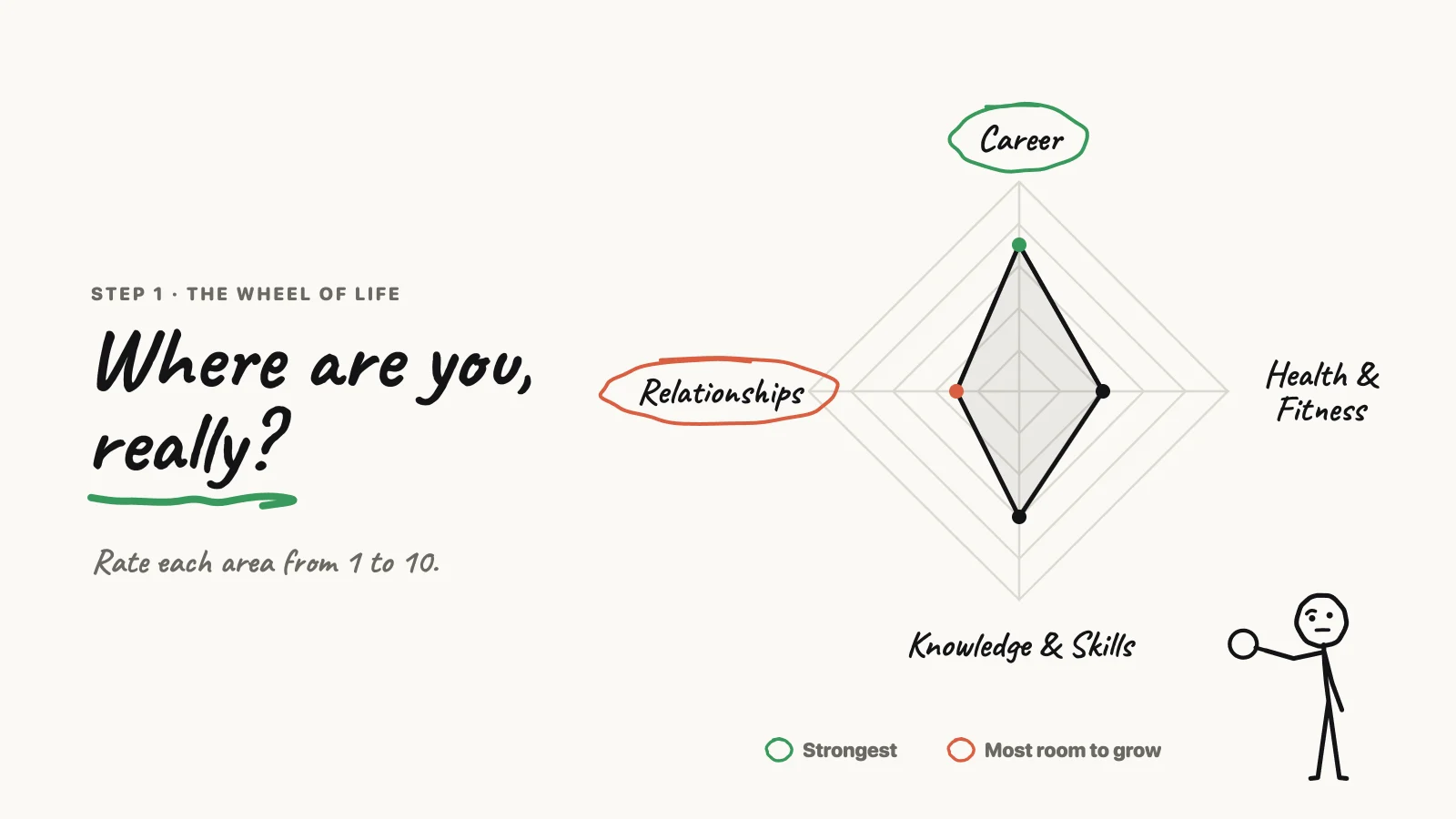
Most people plan their year from where they wish they were.
Then they're surprised when the plan collapses by February. It was built on a version of their life that doesn't exist.
The Wheel of Life fixes that. It takes 15 minutes, a pen and a piece of paper, and it shows you, honestly, where you're starting from.
What is the Wheel of Life?
The Wheel of Life is a self-assessment tool popularized by Paul J. Meyer, founder of the Success Motivation Institute, back in the 1960s. Coaches have used it ever since because it does one thing really well: it puts your whole life on one page, so you can see what's being ignored.
You split a circle into the main areas of your life and rate how satisfied you are with each one. That's it. The insight isn't in the drawing. It's in the shape you end up with.
How to do it
1. Draw the wheel
Draw a circle and split it into four slices:
- Career – your work, your business, your income
- Health & Fitness – your body, energy, sleep
- Knowledge & Skills – what you're learning: a language, a craft, a field
- Relationships – your partner, family, friends
You'll find versions with 8 or even 12 areas online. You can use them, but more slices means more to think about and less clarity. Four covers what matters for planning a year, and it fits in your head.
2. Score each area from 1 to 10
1 means "this is a mess." 10 means "I wouldn't change a thing."
Not the score you'd post on Instagram. The real one. If you hesitate between two numbers, pick the lower one. You're the only person who will ever see this.
3. Shade each slice
Shade each slice from the center out, matching its score. A 3 fills a third of the slice. An 8 almost fills it.
Now step back and look at it.
How to read your wheel
A balanced life looks like a full wheel that rolls. Most people's look like a deflated tire with one flat side.
Ask yourself three questions:
- Which area has the most room to grow? Usually the lowest score. Sometimes it's not the lowest, but the one that bothers you most.
- Which area is quietly carrying the others? Often career. It's the one you've been feeding while everything else waited.
- What has been sitting at a 3 for years? The relationship you keep postponing. The body you keep promising to deal with "after this busy season."
The busy season never ends. That's the uncomfortable part the wheel makes visible.
Common mistakes
Scoring how you feel today. One bad Monday can drag every number down. Score the last 3 months, not the last 3 days.
Trying to make everything a 10. That's not a plan, it's a fantasy. A great year usually means one or two areas move a lot and the rest don't fall apart.
Doing it once and forgetting it. The wheel is most useful as a before-and-after. Redo it every quarter and compare. If nothing moved, your plan isn't touching the areas that matter.
From the wheel to your goals
The wheel tells you where you are. It doesn't tell you what to do. That's the next step.
For each area, imagine it's December 31, 2027, and ask: what would I be celebrating here? Write one win per area, at most. Then pick the single one that matters most, the one that would make the others easier. That's your main goal for the year (we call it your Misogi).
From there you make it measurable, turn it into weekly actions, and prepare for what will get in the way. The whole process, step by step, is in How to have the best year of your life.
But it starts here. Fifteen minutes, one circle, honest numbers.
FAQ
How often should I do the Wheel of Life?
Once when you plan your year, then once every quarter. Comparing wheels over time is more useful than any single wheel.
What categories should the Wheel of Life have?
Any set that covers your whole life works. Four areas (career, health & fitness, knowledge & skills, relationships) are enough to plan a year without overthinking it.
What if all my scores are low?
Don't try to fix everything at once. Pick the one area that would make the others easier if it improved, and start there.