 ResoluteMake my plan
January 1st feels incredible.
New notebook. New gym shoes. New you. You're going to run, read, save, call your mom more. This is the year.
Then, somewhere around the second week of January, it gets quiet. It's dark at 6pm, work is back at full speed, and the shoes are by the door, untouched.
That moment has a name.
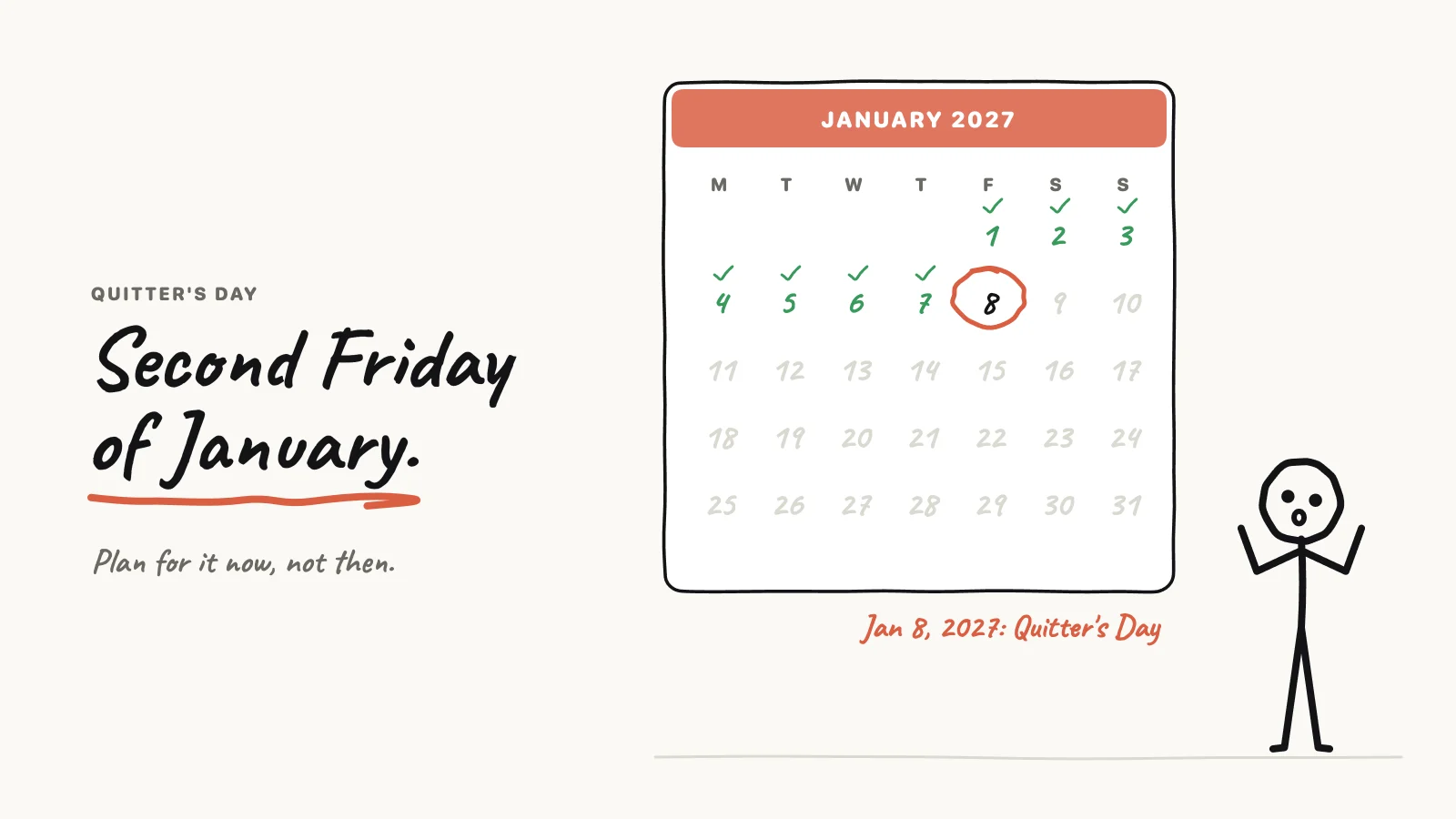
Quitter's Day: the second Friday of January
A few years ago, Strava, the fitness-tracking app, looked at activity data from its users and noticed something: the momentum from New Year's tends to drop off fast, and the second Friday of January was the point where people started to give up. They nicknamed it Quitter's Day. The name stuck, and now it's reported every January.
In 2027, Quitter's Day is Friday, January 8.
It's not magic, and it's not a law of nature. It's what happens when a resolution runs only on the excitement of a new year. Excitement is a great starter and a terrible engine. It lasts about a week.
So the question isn't how to feel more motivated. It's how to build a resolution that keeps working when motivation is gone.
Why resolutions die by February
Most resolutions don't fail because people are lazy. They fail for boring, predictable reasons:
- No finish line. "Get healthier" can't be done, so it can't be tracked, so it quietly disappears. (Here are 40 resolution ideas rewritten with a finish line.)
- Too many at once. Ten resolutions on January 1st means ten new habits fighting for the same tired evenings.
- No time in the calendar. "I'll go to the gym more" without a day and a time is a wish.
- No plan for bad days. The plan was written by the motivated version of you. The tired version never agreed to it.
- All-or-nothing thinking. You miss two days, decide you've "broken" it, and drop the whole thing.
Every rule below answers one of these.
Rule 1: Start before January 1
January 1st is a terrible day to start anything. You're tired, maybe hungover, and you're starting cold, on the hardest day of the year to start.
Instead, do a test week in the last week of December. Run your plan for seven days before it "counts." You'll find out that your 6am workout clashes with the school run, or that 5 workouts a week was 2 too many. Better to find that out on December 27th than on January 8th.
New beginnings do help. Researchers call it the fresh start effect: people are more likely to start working on goals after dates that feel like a new chapter, like New Year's, a birthday or a Monday. Use it. Just make sure January 1st is the day your plan goes official, not the first day you try it.
Rule 2: Make it small enough to survive a bad week
Your resolution has to fit the week you actually have, not the week you wish you had.
If you can't imagine doing it on your worst week of the year, shrink it. Three 20-minute workouts beat five one-hour workouts you'll stop doing in two weeks. You can always add more in March. It's much harder to restart in March after quitting in January.
Rule 3: Never miss twice
You will miss a day. Everyone does. A sick kid, a late meeting, a bad night of sleep.
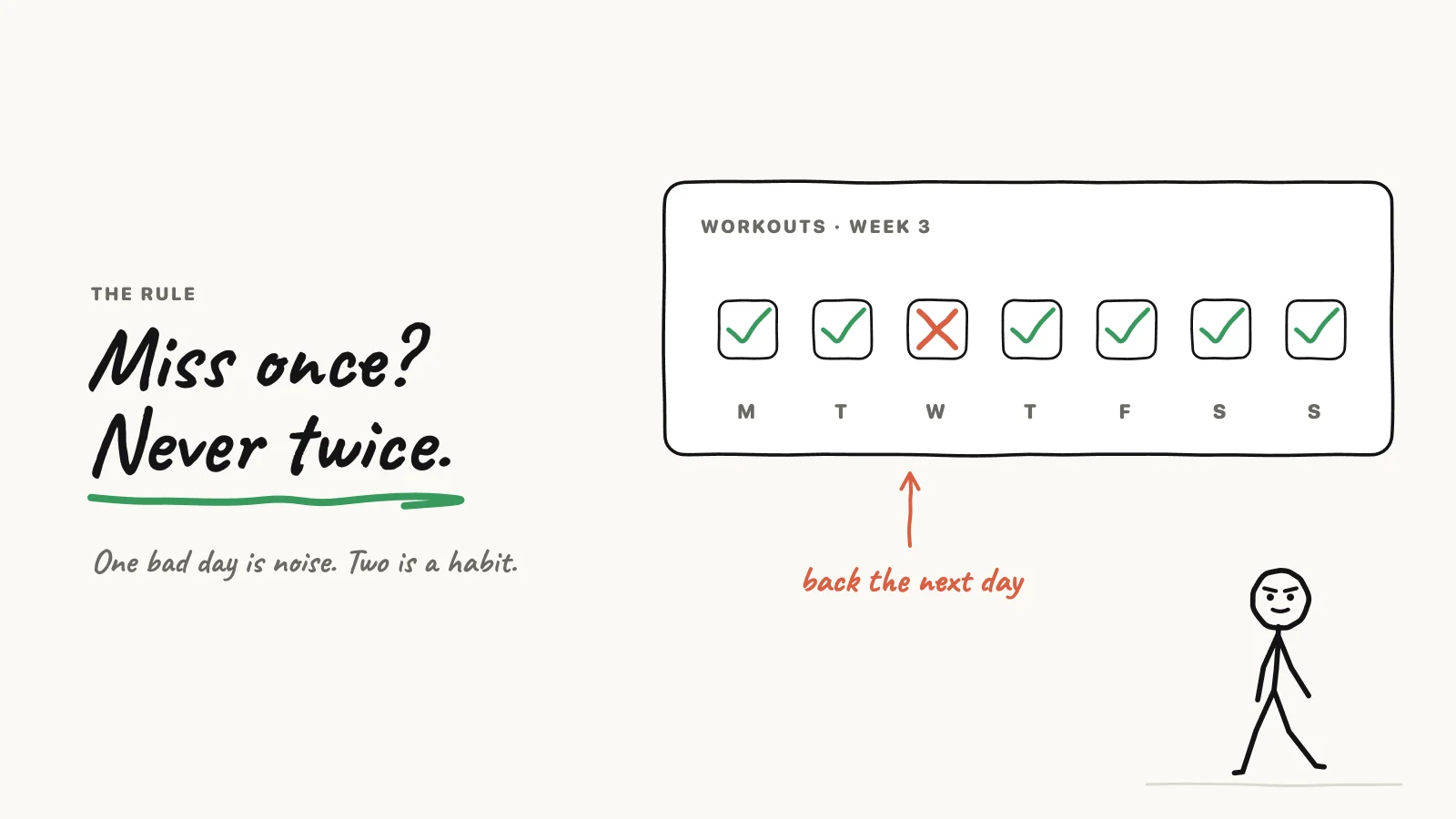
Missing once doesn't matter. What matters is what happens next. The rule, popularized by James Clear in Atomic Habits, is simple: never miss twice in a row. One missed day is an accident. Two is the start of a new habit, and it's not the one you wanted.
It also kills all-or-nothing thinking. A week with one miss isn't a failed week. It's a 6 out of 7.
Research on habit formation backs this up. In a well-known study at University College London, led by Phillippa Lally, missing a single day didn't meaningfully hurt people's progress in building a habit. It's the long breaks that do the damage.
Rule 4: Decide now what you'll do when it gets hard
Most resolutions die in a specific moment: 7pm, tired, phone in hand. In that moment, "I'll start again tomorrow" sounds completely reasonable.
So make the decision now, while you're calm. An if-then plan links a predictable obstacle to a specific action:
- If I get home exhausted, then I put on my running shoes and go for 10 minutes.
- If work gets crazy, then I protect my 3 most important blocks and drop the rest.
- If it's Quitter's Day and I want to stop, then I wait until my Sunday review to decide.
They sound almost too simple, but they're one of the most studied tools in goal research. Here are 30 if-then examples to steal from.
Rule 5: Tell one person
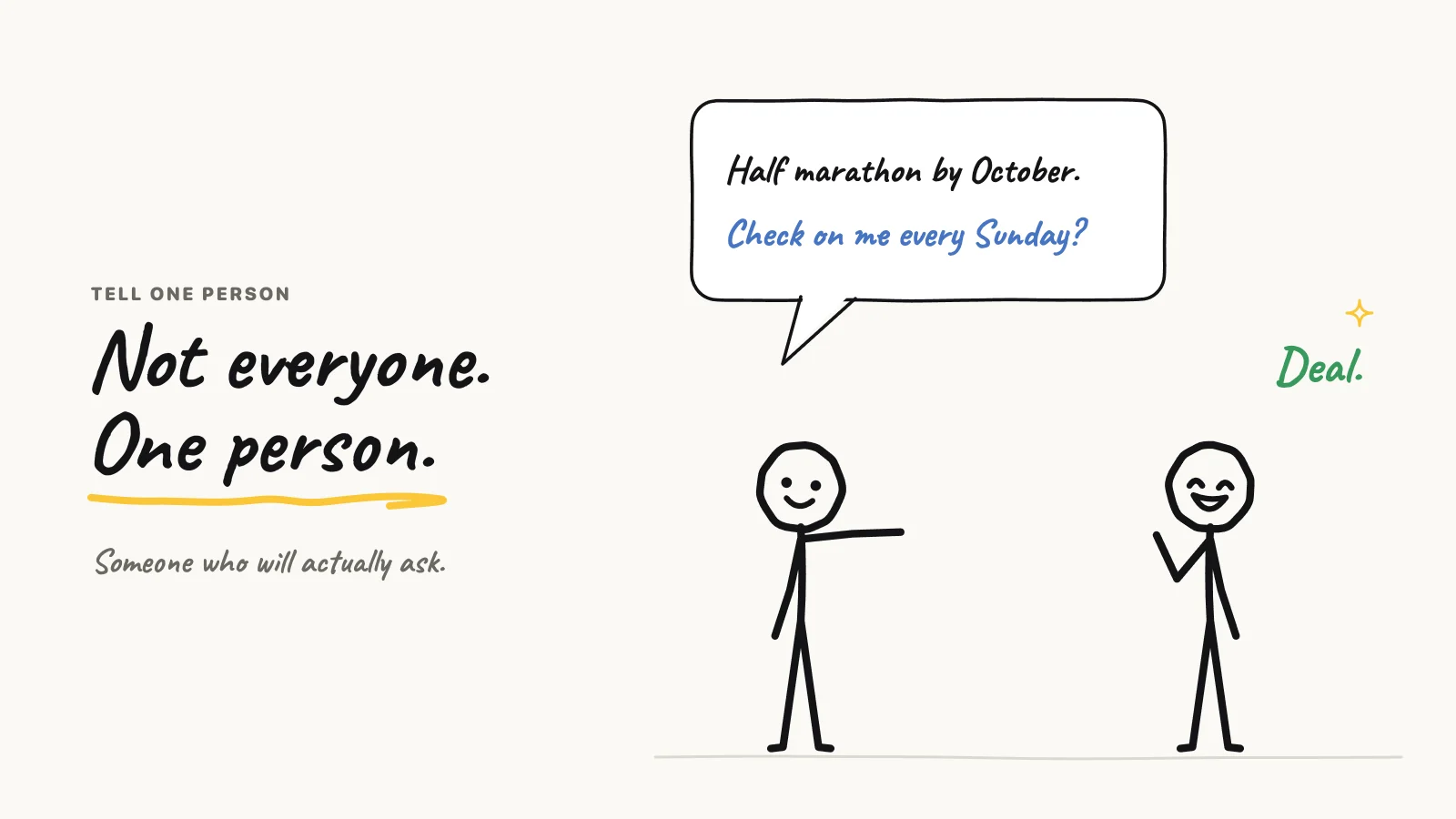
Not Instagram. Not everyone at work. One person who will actually ask you about it.
In psychologist Gail Matthews' study on goal achievement, the group that wrote their goals down and sent a weekly progress update to a friend did the best of all the groups.
There's a catch worth knowing about: some research suggests that just announcing a goal can give you a little of the satisfaction of having done it, which is the opposite of what you want. So don't announce. Ask for a check-in. "I'm running a half marathon in October. Can you ask me every Sunday how my week went?" That's a commitment, not a performance.
Rule 6: Look at it every week
A resolution you don't look at is a resolution you don't have.
Once a week, ideally Sunday, take 20 minutes and ask: What did I actually do? What got in the way? What's the plan for next week? That's how you catch "at risk" in February instead of discovering "abandoned" in June. The full routine is in The weekly review: 5 questions.
Then, a month in, at the end of January, do a slightly bigger check. Not "did I do everything perfectly?" but "is this plan still the right size?" Adjust it. Adjusting a plan isn't quitting. It's how plans survive.
Put it together
Here's the short version:
- Give your resolution a finish line.
- Test-drive it in the last week of December.
- Make it small enough for your worst week.
- Never miss twice.
- Write if-then plans for your real obstacles.
- Tell one person, and ask them to check in.
- Review it every Sunday.
That's most of a real plan already. The complete system, from the Wheel of Life to the weekly review, is in How to have the best year of your life. Or build your 2027 plan for free in a few minutes.
FAQ
What is Quitter's Day?
Quitter's Day is the second Friday of January, the point where many people give up on their New Year's resolutions. The name comes from Strava, which spotted the drop in its users' activity data. In 2027 it falls on Friday, January 8.
Why do most New Year's resolutions fail?
Usually because they're vague, there are too many of them, they have no time in the calendar, and there's no plan for bad days. Excitement gets you through the first week. A plan gets you through the rest.
What should I do if I already broke my resolution?
Start again the next day, and don't miss twice. Then shrink it: make it small enough that you could do it on your worst week. Missing a day doesn't undo your progress. Quitting does.