 ResoluteMake my plan
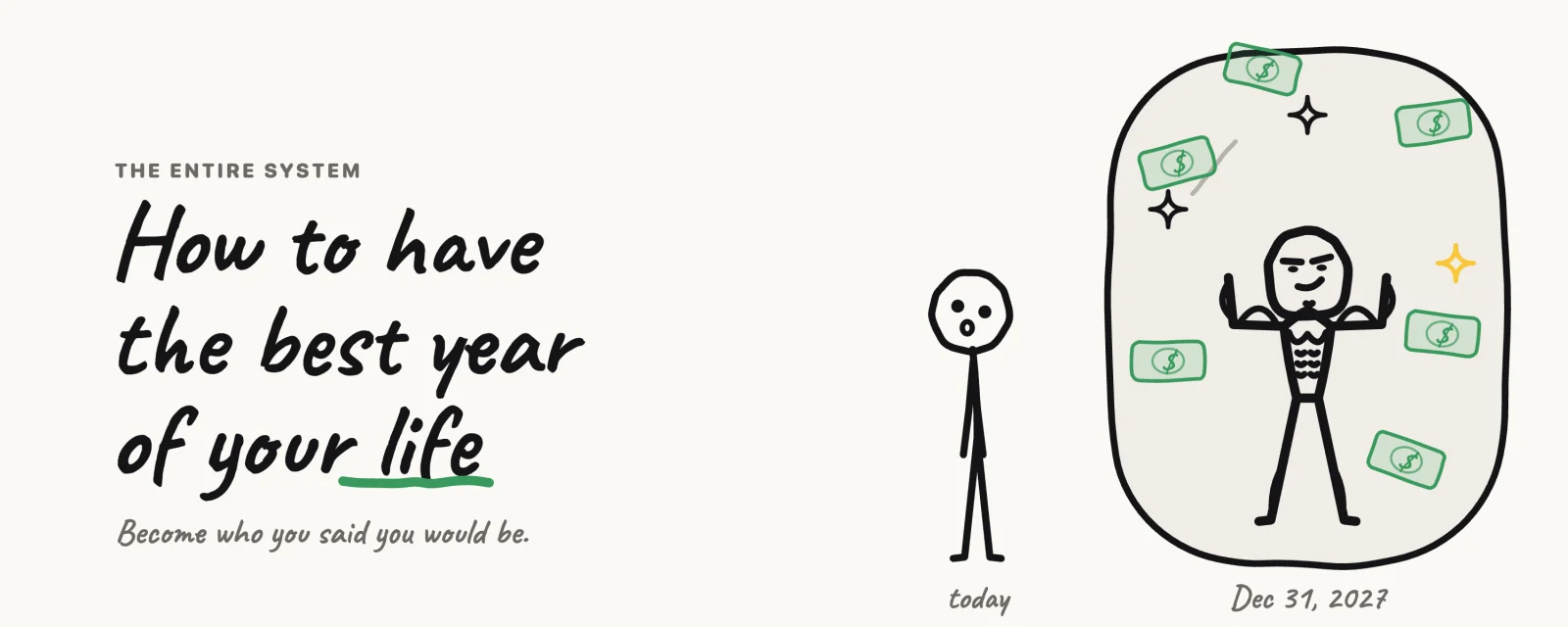
Every January, millions of people sit down and write a list of goals.
Get in shape. Make more money. Start the business. Read more. Learn Italian.
And every December, most of those same people are staring at the same list. Same goals. Same excuses. One year older.
I don't think that's because people are lazy. I've abandoned more goals than I can count, and I don't consider myself lazy. I think it's because nobody ever taught us how to actually plan a year. We were taught how to want things. We were never taught how to make them happen.
A list of goals is not a plan. It's a wish list with better formatting.
So I want to give you the opposite of a wish list. A full system, step by step, that turns "I want a better year" into a week you can actually live. It's the exact process we built into Resolute, but you don't need the app to do it. You need a pen, a notebook, a calendar, and one quiet afternoon.
This will be long.
It's not something you skim on your lunch break and forget about. Bookmark it. Block 3 to 4 hours this weekend. Do it once, properly, and you won't need to do it again until next December.
Let's begin.
I – Your year is already planned (just not by you)
"How we spend our days is, of course, how we spend our lives."
– Annie Dillard
Here's something most people don't want to hear.
Your 2027 is already planned.
Your boss planned part of it. Your inbox planned another part. Your phone has a very detailed plan for roughly four hours of every single day. Your family's expectations, your friends' weekend habits, the default "this is just how things are" – all of it is quietly filling your calendar right now.
Nothing about that is evil. It's just what happens to empty space. If you don't decide what goes in your year, something else will.
If you spend 4 hours a day on your phone, that's 1,460 hours a year. Almost 61 full days. Two months of your life, awake, staring at a screen.
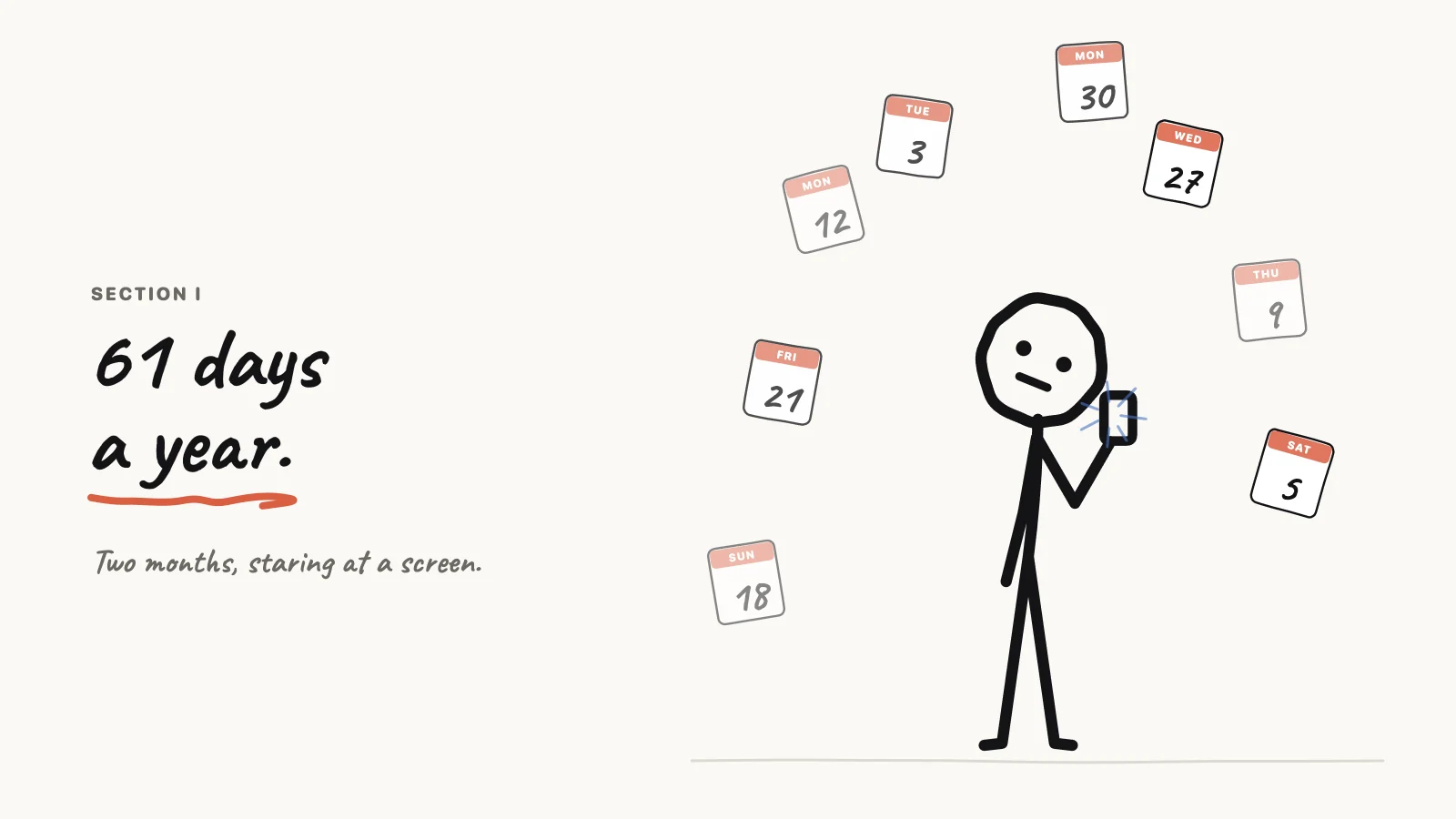
You don't have a time problem. You have a "nobody gave this time a job" problem.
That's the entire premise of what follows: you decide what your year is for, and you put it in your week before anything else gets there.
II – Why most goals die by February
"You do not rise to the level of your goals. You fall to the level of your systems."
– James Clear
Before we build anything, you need to understand why the usual approach fails. Otherwise you'll do the same thing with a nicer notebook.
Goals usually die in one of five ways.
1. Too many, with no priority. Ten goals pull you in ten directions. By March you've done a little of everything and a lot of nothing.
2. No finish line. "Get in shape" doesn't tell you what to do tomorrow morning. You'll never know if you made it, so you'll never feel like you're getting closer.
3. A goal, but no plan. You know what you want. You have no idea what has to happen first, or what you're supposed to do on a random Wednesday.
4. A plan built for the motivated version of you. On January 1st, it's easy to picture yourself going for that run. On a rainy Tuesday in March, with your phone right there, "I'll do it tomorrow" sounds completely reasonable.
5. Out of sight, out of mind. You write the goals in a note and never open it again until December. A goal you don't look at is a goal you don't have.
Every step in this system exists to kill one of those five. Keep that in mind as we go.
III – The system
It has six phases:
- Discover – See your life clearly, as it is today
- Define – Choose what you'll celebrate in a year, and make it measurable
- Plan – Turn each goal into what has to happen, what you'll do, and when
- Protect – Decide what you won't sacrifice and prepare for what will try to stop you
- Run – Track, review, and adjust, every day, week and quarter
- Commit – Put it all on one page and sign it
Get your notebook.
Phase 1 – Discover: where are you actually starting from?
Most people plan their next year as if they were starting from nowhere. You're not. You're starting from somewhere very specific, and if you don't look at it honestly, your plan will be built on a fantasy.
Step 1 – The Wheel of Life
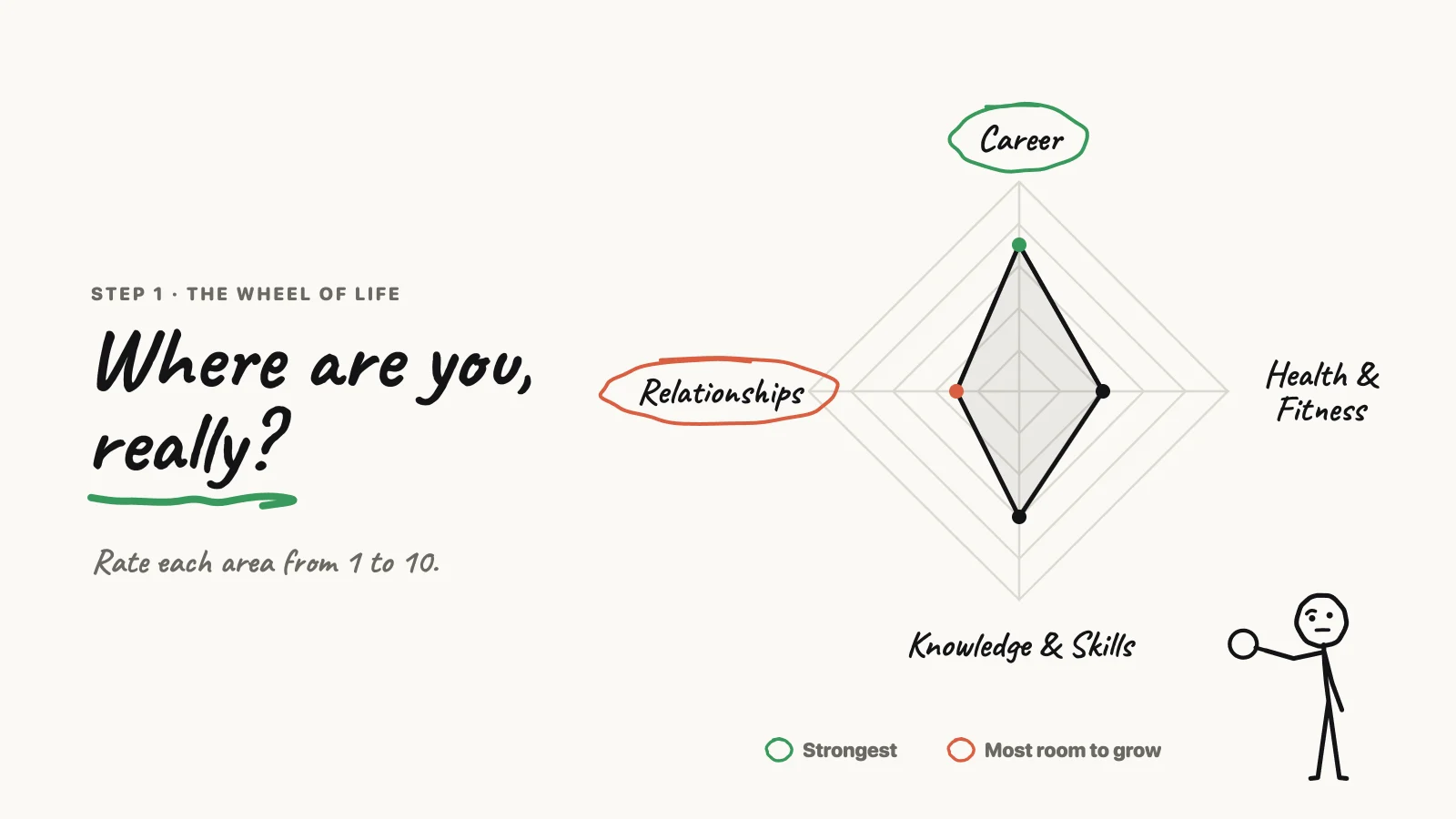
Draw a circle and split it into four slices:
- Career – your work, your business, your income
- Health & Fitness – your body, energy, sleep
- Knowledge & Skills – what you're learning: a language, a craft, a field
- Relationships – your partner, family, friends
Now score how satisfied you are with each area, from 1 to 10. Shade each slice to match its score, from the center out. (More on how to read it in the Wheel of Life guide.)
Not the score you'd post on Instagram. The real one.
Or do it right here:
Step 2 – Your starting point
Look at the shape you just drew. A balanced life looks like a full wheel. Most people's look like a deflated tire with one flat side.
Ask yourself: which area has the most room to grow?
Here's what usually happens. People realize they've been obsessing over one area (often career) while another one has quietly been sitting at a 3 for years. The relationship they keep postponing. The body they keep promising to deal with "after this busy season."
The busy season never ends.
Every transformation starts somewhere. This is where yours starts. No judgment. Just a snapshot.
Phase 2 – Define: what are you celebrating on December 31st?
Step 3 – The celebration dinner

This is my favorite exercise in the whole system, so take your time with it.
Imagine it's December 31, 2027. You're at dinner with your closest friend. Glasses up. You're toasting to your year – and it was the best year of your life.
What are you celebrating?
Write each win as if it already happened. Not "I want to get fit." Write "I got my dream body." Not "I'd like to learn Italian." Write "I speak Italian fluently."
Write up to one win for each area of your wheel. If something doesn't fit any slice, it's fine, add it anyway. Don't overthink it yet. You'll make them precise in a minute.
Notice what this does. Instead of starting with a list of things you should do, you start with the year you want to have lived. Everything else gets reverse-engineered from that dinner.
Step 4 – Choose your Misogi
Now look at your list. You can't give everything the same amount of attention. You need a main goal.
Misogi is an old Japanese ritual for a challenge that changes you. In this system, your Misogi is your main goal for the year: the one that gets the most of your time and attention. The others still matter. But when the year gets chaotic (it will), this one gets protected first.
To choose it, ask:
- Which of these would make the others easier?
- If I did it, would I still be proud of it when I'm 80?
- Which one scares me a little?
Circle it. That's your Misogi. (Where the idea comes from, and more examples: What is a Misogi?)
Step 5 – Give every goal a finish line
A real goal has a finish line. Something you can see happen, by a date.
"Make more money" has no finish line. You could make one more dollar and technically succeed. You could make a million and still feel like you failed.
Go one goal at a time, starting with your Misogi, and decide which kind of goal it is:
A number you'll hit. Best when progress is countable. Write it as: From [where I am today] to [target] by [date]. → "From $2K to $10K a month by December 31." → "From 0 to 1,000 subscribers by June 30."
Writing down your starting point matters. It's how you'll know, every single week, whether you're ahead or behind.
A moment that will happen. Best when success is one event. Picture the moment you'd say "I did it." Write it as: By [date], I'll have [moment]. → "By June 30, I'll have given a talk on stage." → "By October 15, I'll have crossed a marathon finish line."
If a goal can't fit one of those two sentences, it isn't finished yet. Keep rewriting it until it does.
Why bother? In a study by psychologist Gail Matthews, people who wrote their goals down achieved significantly more than people who only thought about them – about 42% more in the most quoted result. And the people who also sent weekly updates to a friend did even better. Hold onto that last part. We'll come back to it.
Phase 3 – Plan: from "I want" to "I'm doing"
This is where 95% of goal-setting advice stops. "Now go crush it." Thanks.
A goal tells you where you're going. It doesn't tell you how to get there. So we build the bridge in three layers.
Step 6 – What has to happen?
For each goal, ask: what has to be true for this goal to come true?
Not the goal again. And not what you'll do yet. The 2 or 3 things that must happen first. If they happen, the goal almost happens by itself.
Say your goal is "From $2K to $10K a month with my agency by December."
- ❌ "Make $10K a month" – that's just the goal again.
- ❌ "Post on LinkedIn every day" – that's an action. We'll get there.
- ✅ "Land 5 retainer clients at $2K each."
- ✅ "Have a reliable way to get 10 sales calls a month."
Or "Run a marathon by October":
- ✅ "Be able to run 30K without getting injured."
- ✅ "Be signed up for a race."
This one step is where most plans quietly fail. People jump straight from the goal to random actions, without asking what actually moves the needle. Then they work hard for months on things that don't matter.
Step 7 – What will you do, and how often?
Now, for each of those things that have to happen, decide what you'll actually do. And here's the key rule: focus on actions, not outcomes.
"Lose 2 kilos this month" is an outcome. You don't fully control it. "Strength training 3× a week" is an action. You control it completely.
Then decide how often:
- Every week → it becomes a habit. ("Strength training, 3× a week.")
- A few times a month or a year → you just keep count. ("Visit my parents 6 times this year.")
- Once → it's a step. List the steps in order and give each one a month. ("March: build the website. April: send 50 cold emails.")
If what you wrote sounds like the result again ("get 5 clients"), make it something concrete you'd do on a given day ("send 10 personalized emails every Monday").
Step 8 – Build your ideal week
Now we make it real. Take a blank weekly calendar and put in the fixed parts of your life first: sleep, work, commute, meals.
Then place each weekly habit on a specific day and time.
- Monday, Wednesday, Friday, 7:00 am: strength training.
- Monday, 9:00 am: outreach emails.
- Sunday, 6:00 pm: weekly review (more on this later).
Treat these blocks like meetings with the most important person in your life. Because they are.
When you're done, you're looking at your ideal week. Not a fantasy schedule where you wake up at 4 am and meditate for an hour. A week that a real, tired, busy version of you could actually live. That's the week that's going to deliver your year.
Step 9 – Find your why
Think of an iceberg.
Your goal is the tip. It's what people see. Your why is everything underneath – and it's what keeps you going when motivation is gone.
For each goal, especially your Misogi, ask: why does achieving this really matter to me? Then ask why again. And again. The first answer is usually the one you'd tell at a party. The third one is usually the real one.
"I want $10K a month" → "So I can quit my job" → "Because I don't want my kids to grow up watching me hate my life the way I watched my dad."
That's a why. Keep it private. Nobody else needs to see it.
This isn't just a feel-good exercise. Research on what psychologists call self-concordant goals suggests people put more sustained effort into goals that come from their own interests and values than into goals chosen to impress someone else. If you dig and the real why turns out to be "so people think I'm successful," that's worth knowing. You might be chasing the wrong goal.
Step 10 – Plan your year in chapters
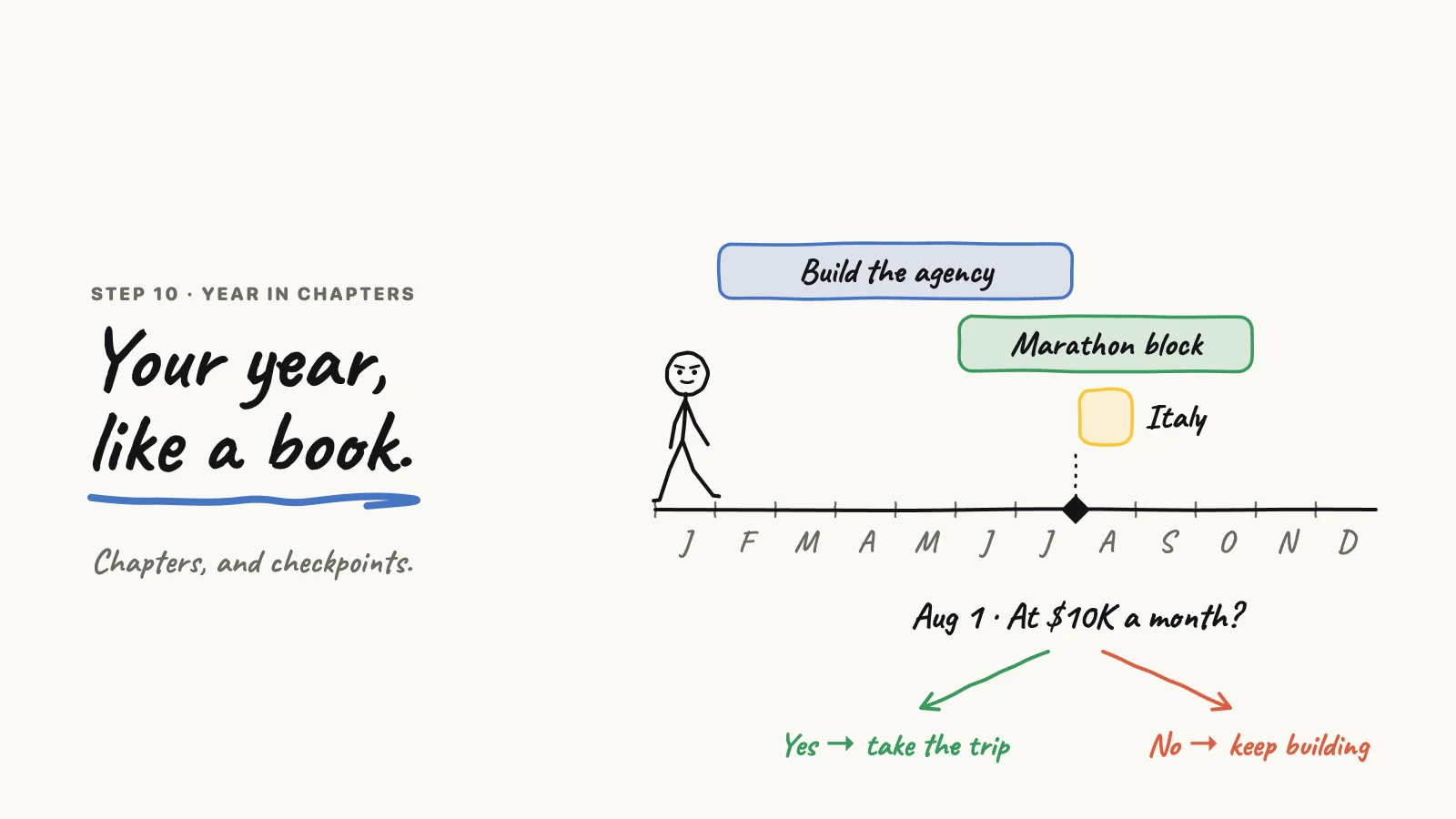
Now zoom out to the full year. Get a page with all 12 months on it.
Don't think of your year as 365 identical days. Think of it like a book, with chapters. Group months together around what that stretch is for:
- "Build the agency · Feb–Jul"
- "Marathon training block · Jun–Oct"
- "Month in Italy · August"
Then add checkpoints: specific days where you stop and decide what's next. Every checkpoint has a question, a "yes" path, and a "no" path.
→ "Aug 1 · Am I at $10K a month? Yes → I take the trip. No → I keep building and push it to December."
This is the part most people never do, and it changes everything. You're not just hoping the year goes well. You already know what you'll do if it doesn't. A ship doesn't sail in a straight line. It drifts and corrects. Checkpoints are where you correct.
Phase 4 – Protect: prepare for the version of you that wants to quit
"Everyone has a plan until they get punched in the mouth."
– Mike Tyson
You now have a beautiful plan. Here's the uncomfortable truth: it was built by the motivated version of you. That version won't be around every day. This phase is for the other one.
Step 11 – Know your obstacles
Write down what has held you back in the past. Be specific and be honest. The usual suspects:
- Procrastination
- Lack of consistency
- Poor time management
- Fear of failure
- Not having a clear plan
Circle the ones that are true for you. Add your own. Progress gets easier when you understand what's standing in your way.
Step 12 – What are you NOT willing to sacrifice?
This is the question nobody asks, and it's why so many people "succeed" and end up miserable.
Draw a circle. Inside it, write the things you won't give up to reach your goals. Your relationships. Your mental health. Your sleep. Your values.
Success shouldn't require giving up everything that matters. If your plan from Phase 3 only works by breaking something inside this circle, the plan is wrong, not you. Go back and fix it.
Step 13 – Look into the crystal ball
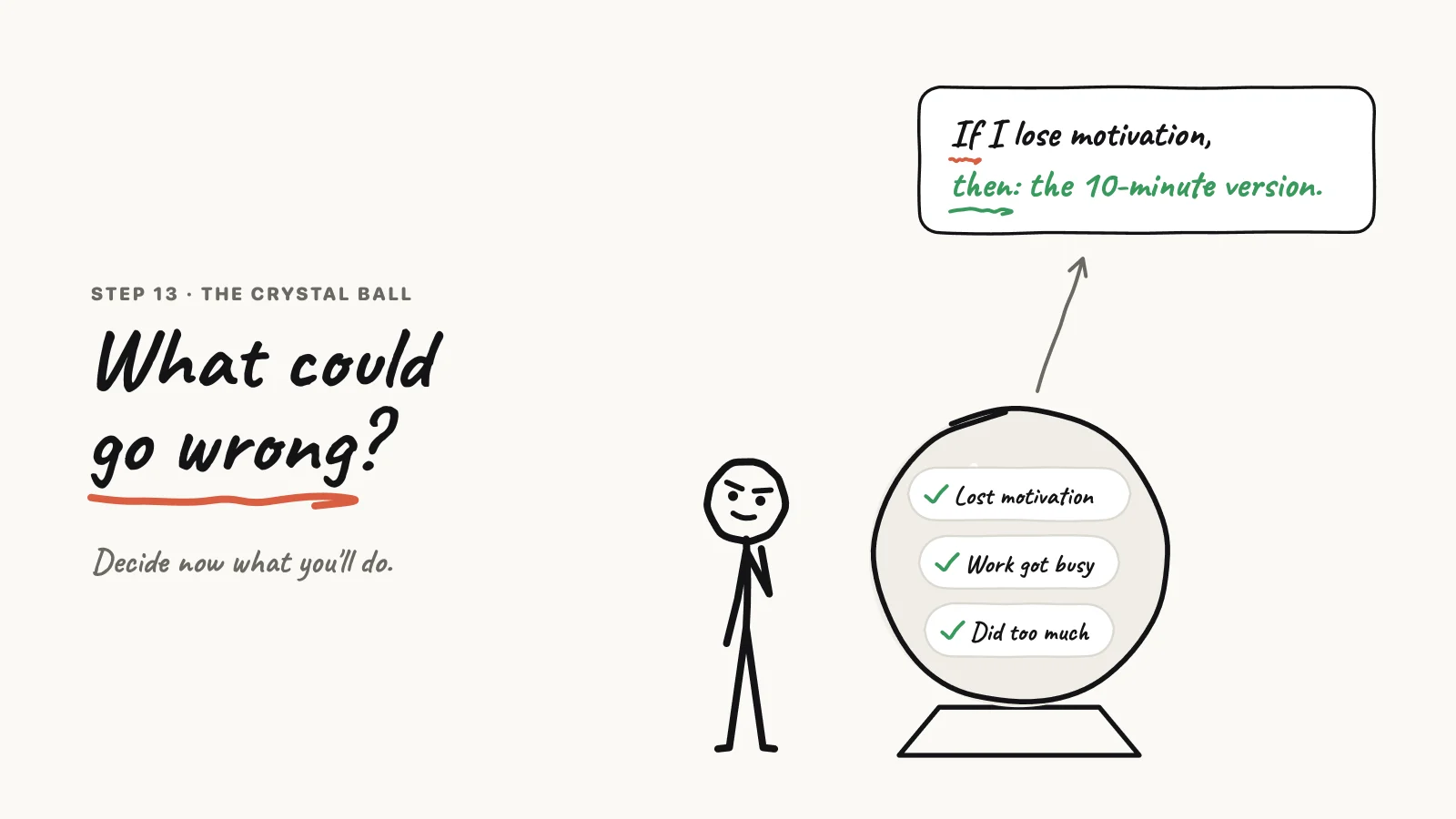
Psychologist Gabriele Oettingen at NYU spent decades studying positive thinking and found something counterintuitive: only dreaming about a positive future can leave you less energized to pursue it. Your brain gets a little taste of the reward without doing any of the work.
What tends to help more is imagining the future you want, then honestly facing what could stand in the way, and planning for it. She turned this into a method called WOOP: Wish, Outcome, Obstacle, Plan.
So here's the exercise.
Imagine it's December 31, 2027. Same dinner as before. But this time, you didn't achieve your goal. Not even close.
What went wrong? Name up to 3 reasons.
- "I lost motivation after a few weeks."
- "Work got too busy."
- "I tried to do too much at once."
- "I got sick or injured and never restarted."
Now, for each reason, decide right now what you'll do when it shows up:
If [obstacle], then I will [response].
- "If I lose motivation, then I'll re-read my why and only do the 10-minute version that day."
- "If work gets crazy, then I protect my 3 Misogi blocks and drop everything else."
- "If I miss a day, then I never miss two in a row."
These are called implementation intentions (30 more examples here), and they're one of the most researched tools in behavior psychology. They work because you make the decision now, while you're calm and motivated, instead of on that tired Tuesday when your brain is negotiating its way out.
You just stopped three failures before they happened.
Step 14 – Break the habits that are working against you
Building good habits is half of it. The other half is stopping the ones quietly undoing your progress.
Pick the bad habits you're done with. And for each one, choose a replacement, because a habit you remove leaves a gap, and gaps get filled.
- Too much social media → phone in another room during focus time
- Procrastinating → start with a 5-minute version
- Staying up late → screens off 30 minutes before bed
- Skipping workouts → lay out my gear the night before
- Scrolling first thing in the morning → read or move for 10 minutes first
Then, every day, mark each one: avoided, replaced, or slipped. You're not aiming for perfect. You're aiming to watch them fade.
Phase 5 – Run: the plan only works if you keep looking at it
Here's the truth: the plan you make this weekend will be wrong. Not completely wrong. But life will happen. That's fine. What matters is that you notice early and adjust.
Step 15 – Track your actions and your results
Track two things, separately:
- Actions (inputs): Did I do what I said I'd do? Check a box every time you do a habit. Workouts done. Emails sent. Hours practiced.
- Results (outputs): Is it working? Your weight. Your monthly revenue. Your long-run distance.
You control the inputs. The outputs show you if it's working. If you're doing everything and the results aren't moving, the problem isn't discipline, it's the plan. If the results aren't moving because you're not doing the actions, the problem isn't the plan.
Without both, you'll never know which one it is.
A meta-analysis covering nearly 20,000 participants found that getting people to monitor their progress improved goal attainment. Progress is easier to manage when you can see it.
Step 16 – Know where you stand
Remember the starting point and target from Step 5? Draw a straight line between them across the year. That's your progress line.
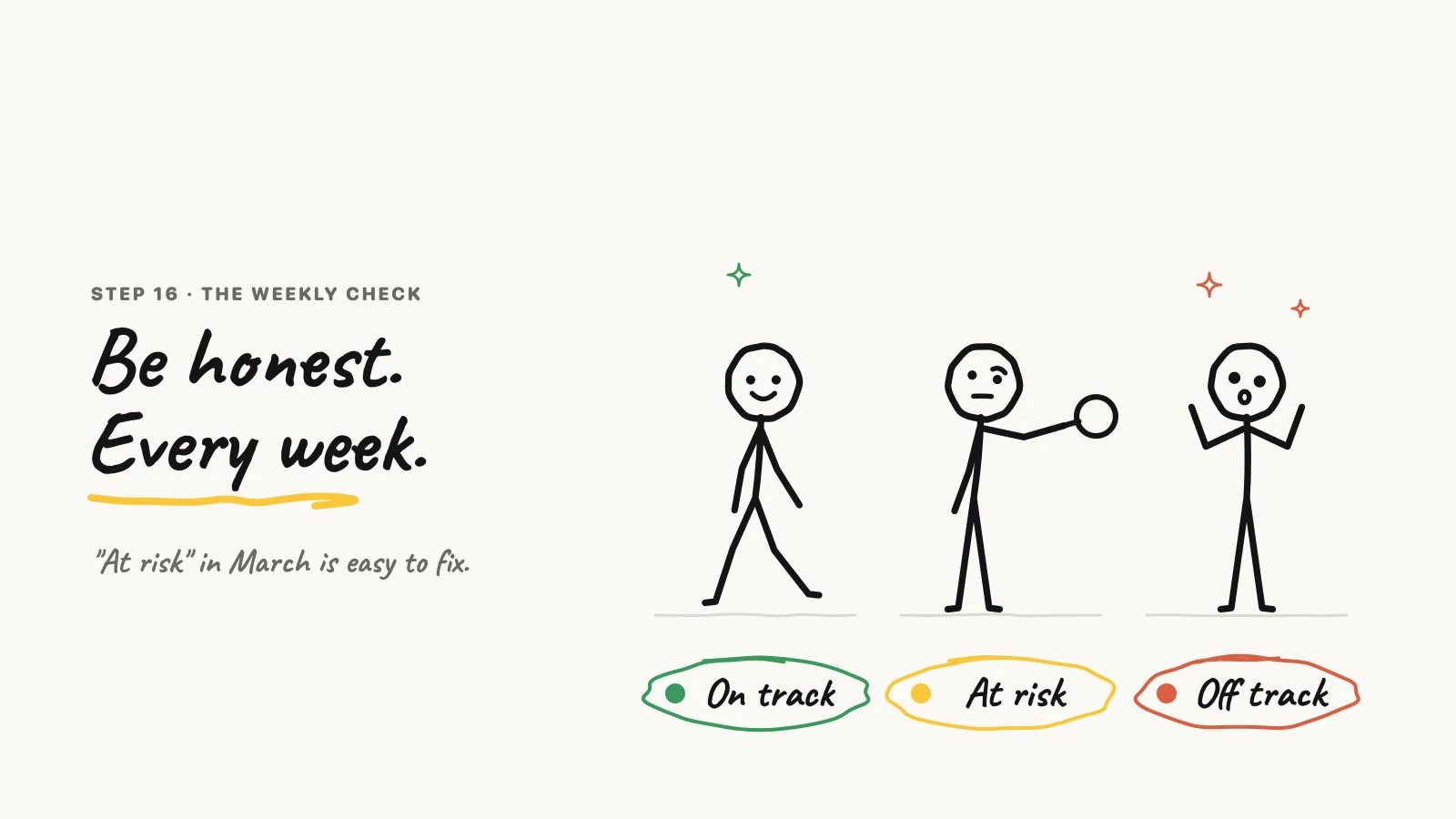
Every week, put a dot where you actually are, and ask which of these is true:
- 🟢 On track – you're progressing as planned.
- 🟡 At risk – you're falling behind, but you have a recovery plan.
- 🔴 Off track – you're behind and need a new plan.
Be honest. "At risk" in March is easy to fix. "Off track" discovered in November is a regret.
Step 17 – Review, plan, repeat
This is the step people skip, and it's the one that matters most. There are three loops.
Daily (2 minutes, before bed):
- What did I accomplish today?
- What did I struggle with?
- What did I learn?
- What should I do tomorrow?
Weekly (20 minutes, Sunday evening):
- What progress did I make?
- Which habits were consistent?
- What prevented progress?
- What can I improve next week?
- What are next week's priorities?
Quarterly (1 hour, every 3 months):
- Did I reach my milestones for this quarter?
- Am I on track for my annual goals?
- Is my strategy working?
- What needs to change?
- What are my goals for the next quarter?
Twenty minutes a week, fifty-two times a year. (A full weekly review template.) A goal you look at every week is a goal you're working on. A goal you look at in December is a regret.
Step 18 – Choose an accountability partner
Remember the goal-writing study? The people who sent weekly updates to a friend did the best of all.
Big goals don't have to be pursued alone. Pick one person. Every week, send them a short message: how consistent you were and how your goals are moving. That's it.
You don't need to share your why. That stays yours. You just need someone who'll notice if the updates stop.
Phase 6 – Commit: make it official
Step 19 – Your blueprint on one page
If you did everything above, your entire year fits on a single page:
- Misogi: my main goal, with its finish line
- Other goals: each with a finish line
- What has to happen: the 2–3 things for each goal
- Ideal week: my habits, on their days and times
- Year in chapters: with checkpoints and their yes/no paths
- If things get hard: my if-then plans
- Not willing to sacrifice: my circle
- Habits I'm breaking: and what replaces them
- Reviews: daily, every Sunday, every quarter
- Accountability partner: their name
You started with a vision. Now you have a plan.
Put this page somewhere you'll see it every day.
Step 20 – Sign it
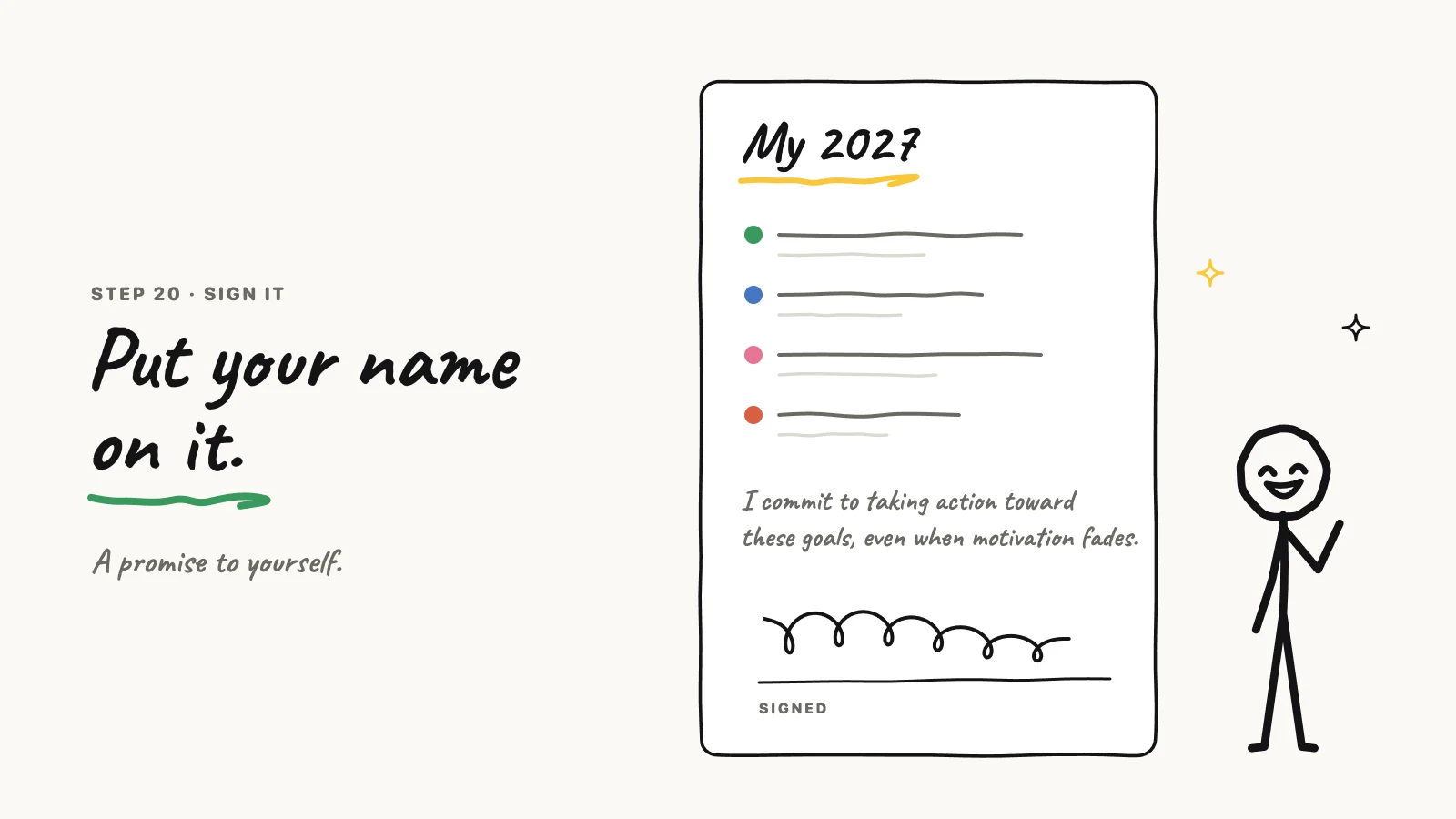
This will sound cheesy. Do it anyway.
At the bottom of the page, write:
"I commit to taking action toward these goals, even when motivation fades."
And sign it.
It's not a contract. Nobody will enforce it. It's a promise to yourself, and there's a reason it works: once you've put your name on something, quitting stops being a quiet decision. It becomes breaking your word to the one person you can never avoid.
Then go do the first thing on your calendar. Not Monday. Not January 1st. The next one.
IV – Back to that dinner
Picture it one more time.
December 31, 2027. Glasses up. Your closest friend across the table asks, "So how was your year?"
There are two versions of that moment. In one, you're toasting to the wins you wrote down a year earlier, the ones that actually happened. In the other, you're making the same list again, wishing you'd started.
Today, both are still possible.
The difference isn't talent, or luck, or how motivated you feel this weekend. It's whether you sat down for one afternoon and decided what your year was for, and then looked at that plan every single week until it was done.
This is the exact system inside Resolute. If you'd rather not do it with pen and paper, the app walks you through every step, helps you plan your entire 2027, and then keeps you on it, day after day, until those goals are done.
But honestly, the notebook works too. Just do it.
FAQ
How do I plan my year?
Work through six phases: find where you're starting from (Wheel of Life), choose what you want to celebrate on December 31 and make it measurable, turn each goal into actions and an ideal week, prepare for what will get in the way, track your actions and results every week, and put the whole plan on one page and sign it. It takes one afternoon of 3 to 4 hours.
What is the Wheel of Life?
A simple self-assessment: split a circle into the areas of your life (here: career, health & fitness, knowledge & skills, and relationships) and rate each one from 1 to 10. Your strongest and weakest areas show you where to focus your goals for the year.
How many goals should I set for the year?
Few. At most one win per area of your life, and one main goal (your Misogi) that gets protected first when the year gets busy. Ten goals with no priority usually means a little progress on everything and real progress on nothing.
What is the WOOP method?
WOOP (Wish, Outcome, Obstacle, Plan) is a method developed by psychologist Gabriele Oettingen. You picture the future you want, then honestly name what could stop you, and plan for it in advance. The crystal ball exercise in Step 13 is inspired by it.
What is an if-then plan?
A decision made in advance: "If [obstacle], then I will [response]." For example: "If I miss a day, then I never miss two in a row." Psychologists call them implementation intentions, and they work because you decide while you're calm, not in the moment you want to quit.