 ResoluteMake my plan
"Visualize your success."
You've heard it a thousand times. Picture yourself crossing the finish line, signing the contract, fitting into the jeans. Feel it. Believe it.
Here's the problem: for a lot of people, it makes things worse.
What the research found
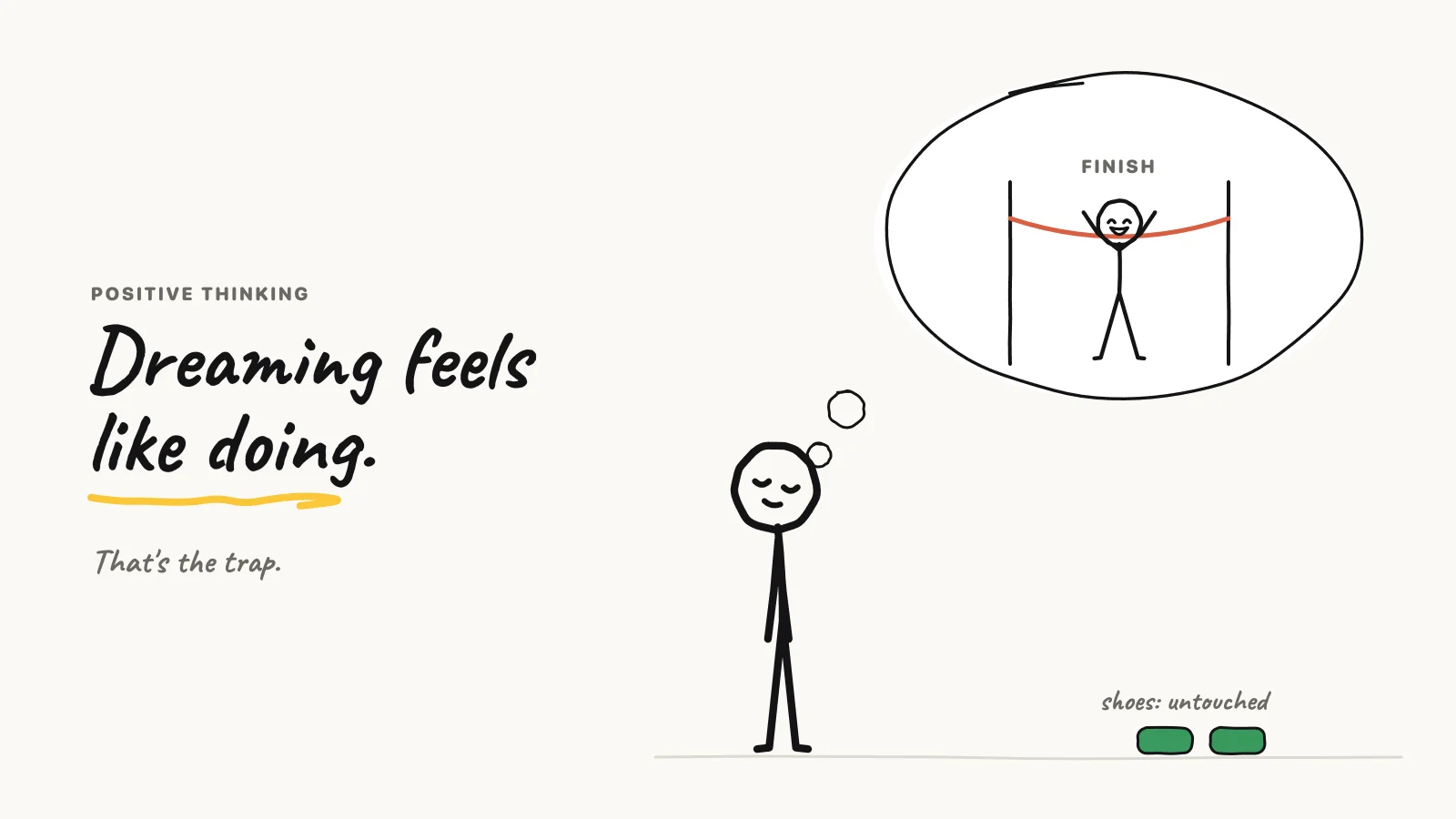
Psychologist Gabriele Oettingen, a professor at NYU, spent decades studying positive thinking. Her finding was counterintuitive: only fantasizing about a positive future can leave you less energized to pursue it.
Your brain gets a small taste of the reward without doing any of the work. You feel good. And then you don't act.
What tends to work better is something she called mental contrasting: imagine the future you want, then honestly face the obstacle inside you that could stop you. She combined that with "if-then" planning (from her husband, psychologist Peter Gollwitzer) and turned it into a simple 4-step method: WOOP.
The 4 steps of WOOP
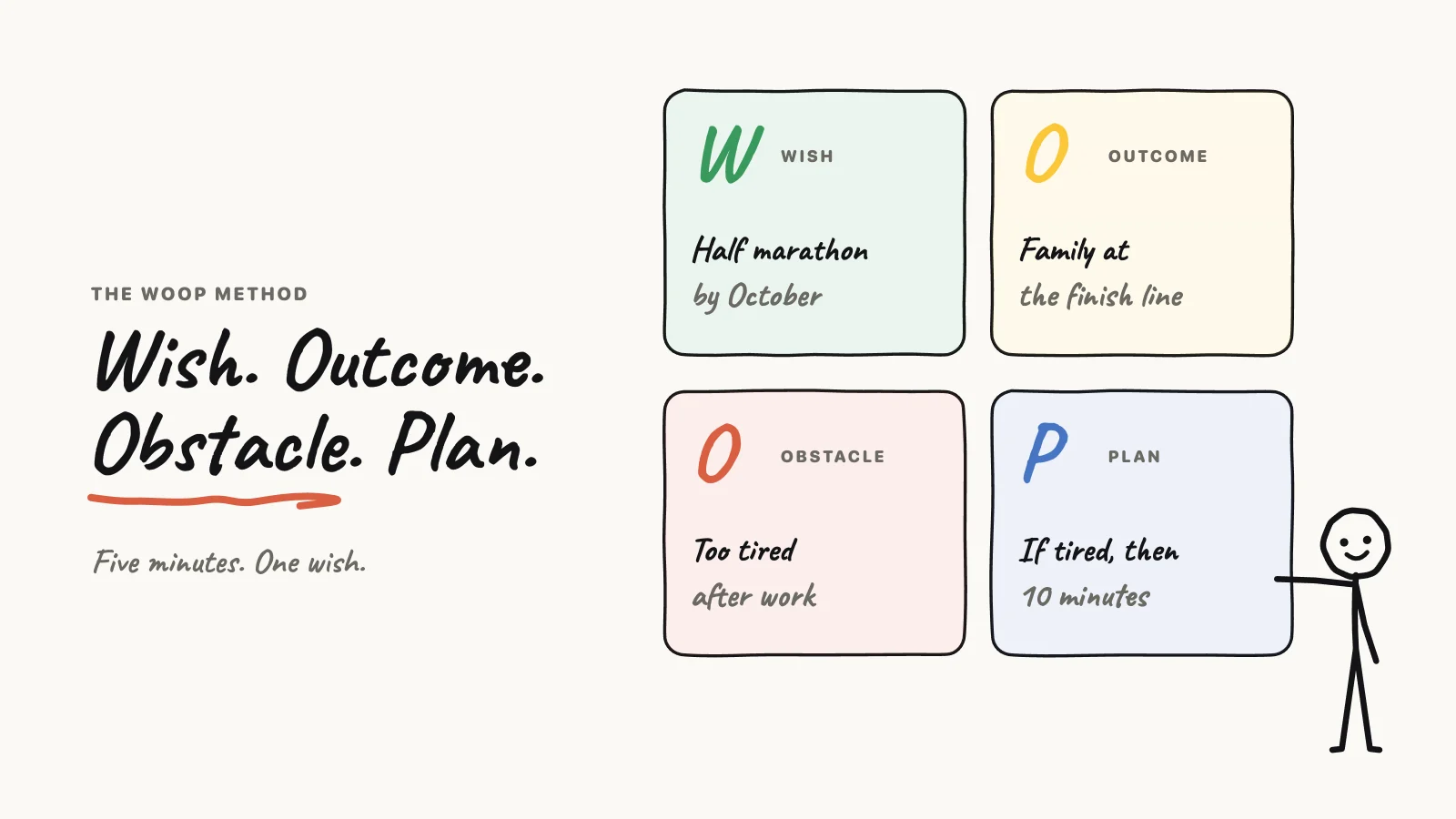
W – Wish
What do you want? Make it challenging but possible. One wish at a time.
"I want to run a half marathon by October."
O – Outcome
What's the best thing about achieving it? How would you feel? Take a minute and really picture it.
"Crossing the finish line with my family there. Proving to myself I can stick to something for months."
O – Obstacle
This is the step most people skip. What is the main thing inside you that could stop you? Not the weather, not your boss. Your habit, your emotion, your excuse.
"After a long workday, I tell myself I'm too tired and skip the run."
P – Plan
Now decide what you'll do when that obstacle shows up. Write it as an if-then:
"If I feel too tired after work, then I put on my running shoes and do just 10 minutes."
That's it. Four steps, five minutes.
Why it works
Two reasons.
It turns the obstacle into a cue. Once you've linked "I feel too tired" to "put on my shoes," the moment you feel tired stops being the start of an excuse. It becomes the trigger for the plan.
You make the decision while you're calm. On a tired Tuesday evening, your brain is excellent at negotiating its way out. WOOP moves the decision to a moment when you're clear-headed, so there's nothing left to negotiate.
WOOP examples
Career
- Wish: get 5 new clients this quarter
- Obstacle: I avoid reaching out because I'm afraid of rejection
- Plan: if I catch myself putting off outreach, then I send just one message before I open email
Health
- Wish: work out 3 times a week
- Obstacle: I hit snooze and the morning is gone
- Plan: if my alarm goes off, then I put my feet on the floor before I decide anything
Learning
- Wish: finish my Italian course by June
- Obstacle: I scroll my phone during the time I set aside
- Plan: if I pick up my phone during study time, then I open the language app instead
The "crystal ball" version
When you plan a full year, there's a version of WOOP that works especially well. Imagine it's December 31 and you didn't achieve your goal. Not even close. What went wrong? Name up to three reasons, then write an if-then plan for each one.
It's the same idea, aimed at a whole year instead of a single wish. It's Step 13 of the full system in How to have the best year of your life, and the if-then plans themselves have their own guide: If-then plans: examples for goals you actually keep.
FAQ
What does WOOP stand for?
Wish, Outcome, Obstacle, Plan. It's a method developed by psychologist Gabriele Oettingen based on her research on mental contrasting.
Is WOOP backed by science?
Yes. It combines mental contrasting (Oettingen) with implementation intentions (Gollwitzer), both studied in many experiments on goal pursuit.
How long does WOOP take?
About five minutes per wish. You can do it in your head, on paper, or in an app.