 ResoluteMake my plan
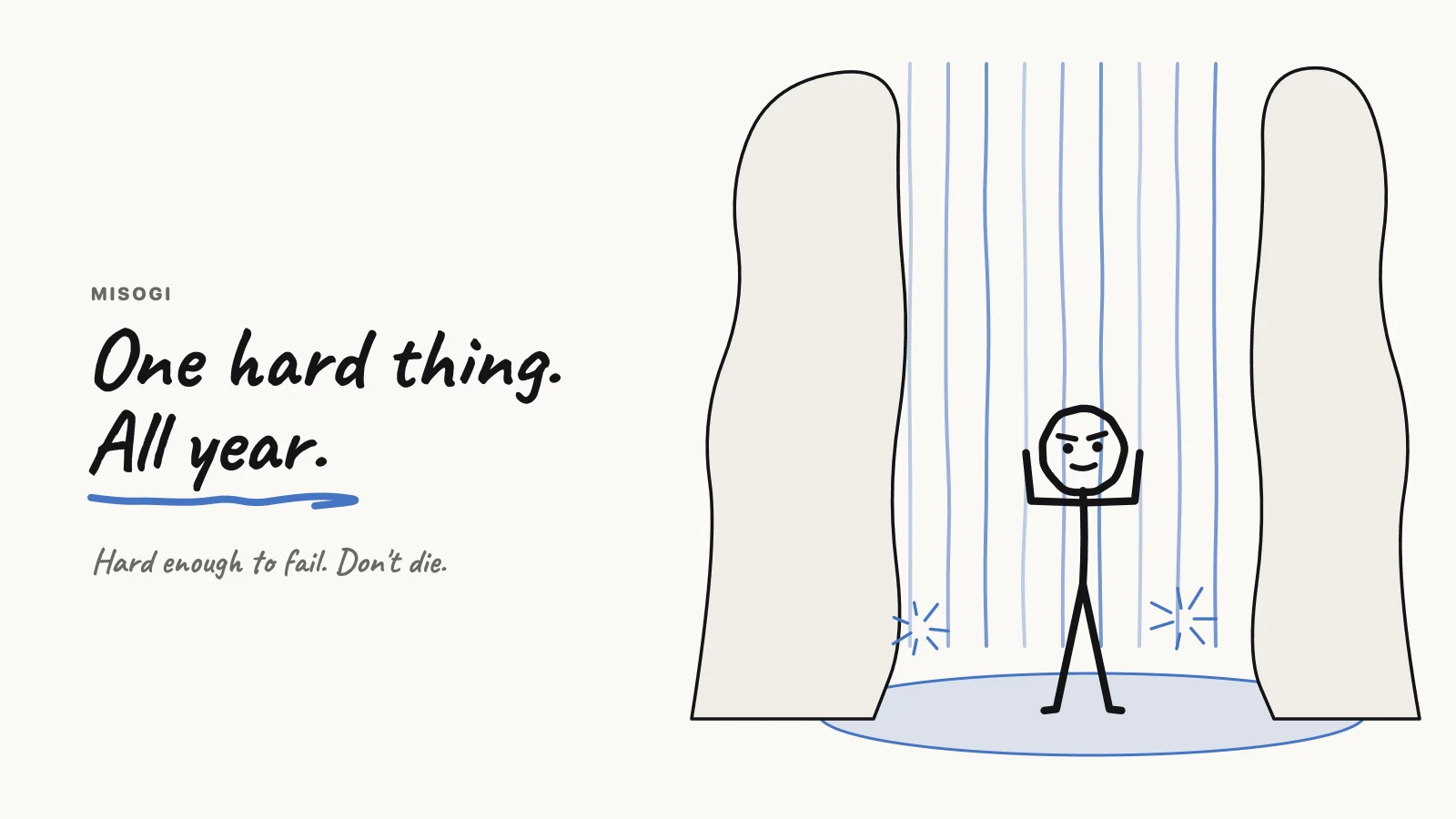
Ask someone about their best year and they won't list ten small wins.
They'll tell you about one thing. The marathon. The business they finally launched. The year they moved countries. One big thing that everything else orbited around.
That one thing has a name: a Misogi.
Where the idea comes from
Misogi is a Japanese Shinto purification ritual. Traditionally, it involves standing under a freezing waterfall to cleanse body and mind.
The modern version comes from Dr. Marcus Elliott, a Harvard-trained physician who works with professional athletes. He and a friend started doing one extremely hard challenge each year, something far outside what they thought they could do. Journalist Michael Easter later made the idea popular in his book The Comfort Crisis.
Elliott's version has two rules:
- It has to be really hard. Roughly a 50% chance you succeed. If you're sure you'll make it, it's not a Misogi.
- Don't die. Hard, not reckless.
The point isn't the challenge itself. It's who you become while chasing it.
A Misogi for your whole year
In the Resolute system, we borrow the idea and apply it to your year: your Misogi is your main goal, the one that gets the most of your time and attention.
You can have other goals. You probably should. But when the year gets chaotic (it will), your Misogi is the one that gets protected first. Everything else bends around it.
This solves the most common reason goals die: having ten of them with no priority. Ten goals pull you in ten directions. By March you've done a little of everything and a lot of nothing.
How to choose yours
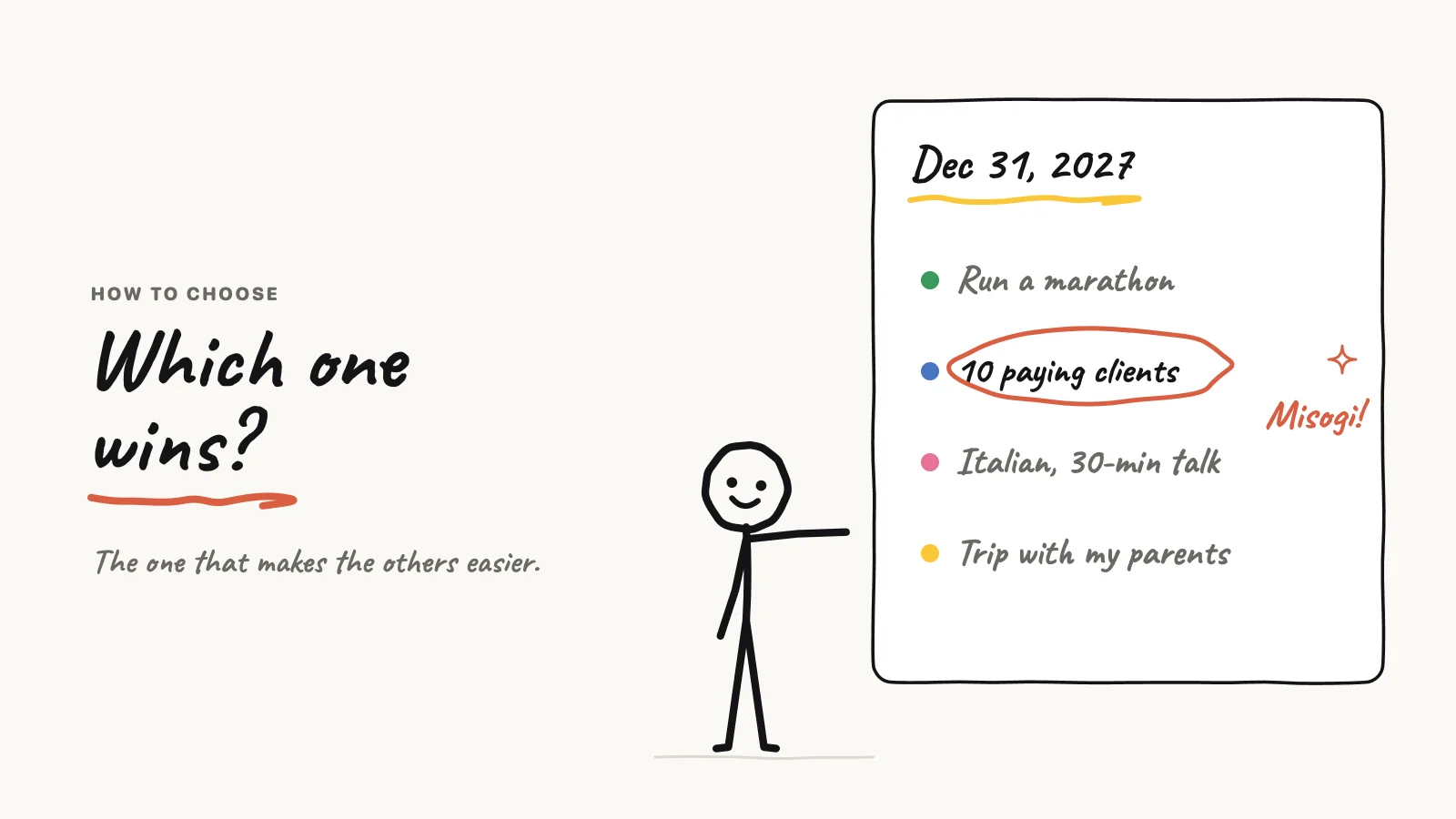
Start with a list. Imagine it's December 31, 2027, and write down what you'd love to be celebrating, at most one win for each area of your life (career, health, learning, relationships).
Then ask three questions about each one:
- Which of these would make the others easier? Getting fit gives you energy for work. Building income gives you time for family. Some goals unlock other goals.
- If I did it, would I still be proud of it when I'm 80? This filters out goals you picked to impress someone.
- Which one scares me a little? That's usually the one that matters.
Circle the one that wins. That's your Misogi.
Misogi ideas
Some examples, across different areas:
- Health: run your first marathon, finish a sprint triathlon, hike a multi-day trail
- Career: launch the business and get your first 10 paying customers, earn $10K in a month from your side project
- Learning: hold a 30-minute conversation in a new language, ship your first app
- Relationships: plan and take the trip you've been postponing with your parents, host a dinner every month for a year
Notice they all have a clear finish line. "Get in shape" isn't a Misogi. "Run a half marathon in under 2 hours by October" is.
Protect it in your calendar
A Misogi without time blocked for it is just a wish.
Once you've chosen it, put it into your week first, before anything else: the training sessions, the work blocks, the practice. Then fill the rest of the week around it. And decide in advance what you'll do when things get busy, for example: "If work gets crazy, I protect my 3 Misogi blocks and drop everything else."
That's a full plan, not just a goal. The complete process (from choosing your Misogi to tracking it every week) is in How to have the best year of your life.
FAQ
What does Misogi mean?
Misogi is a Japanese Shinto purification ritual. Today it's also used for one very hard challenge you take on each year to grow.
What are the rules of a Misogi?
In Marcus Elliott's version: it should be hard enough that you have roughly a 50% chance of success, and you must not die.
Can I have more than one Misogi?
You can have other goals, but only one Misogi. The whole point is to know which goal gets protected when you can't do everything.